← All posts · Writing portfolios
4 Writing Portfolio Mistakes That Can Cost You Clients—and How to Fix Them
Can we discuss something that doesn’t get enough attention?
Your portfolio.
You know that link you send to potential clients hoping they’ll see your brilliance and immediately want to work with you? Yes, that one.
I’ve reviewed several of them over the years and discovered that most writers make the same four mistakes.
So, if it’s not getting the results you want, there’s a good chance the problem may not be your writing.
It might just be how you’re presenting it.
The truth is: clients don’t necessarily hire the best writer. They hire the writer who makes it easiest to believe they’re the right choice.
Your portfolio is like your sales rep, speaking up for you and selling your skills even when you’re not in the room.
If it’s not convincing people to work with you, you’re probably making one (or all) of these mistakes.
Let’s walk through them, and how to fix them.
Mistake #1: Not Reviewing Your Samples for Errors
Let’s start with the obvious one: proofreading.
You’d be surprised how many writers upload samples without double-checking them. Even a small typo can send the wrong message.
Clients are thinking: “If they missed that in their own portfolio, will they miss details in my project too?”
It’s not about perfection, but showing that you respect your craft (and the client’s trust).
Quick question: would you trust a writing portfolio that has errors?
Before you hit send, make sure every piece is clean. Read it out loud. Better yet, ask a fellow writer to review it. My self-editing checklist can help you work through the draft.
Mistake #2: Not Categorizing Your Samples for Easy Navigation
Imagine walking into a bookstore where every book is stacked in random piles. No sections, no signs, no order.
You’d walk right back out, right?
That’s exactly how clients feel when your portfolio isn’t organized.
Make your portfolio simple and scannable.
You’ll instantly look more polished and professional, and clients will trust that working with you will be easy.
Mistake #3: Dropping Links Without Context
Most writers think their samples should “speak for themselves.”
But future employers and clients don’t just want to see random links. They want stories. Short descriptions or just enough context to understand what the piece was meant to do.
Every sample in your portfolio should have an agenda:
- What was the goal?
- Who was it for?
- What result did it get?
Example of the kind of context you could provide, if the results are verified:
“This blog post was written for a wellness brand to drive organic traffic. It ranked on page one within three months and doubled their monthly leads.”
This transforms your work from “look what I wrote” to “look what my writing achieved.” That’s the difference.
Mistake #4: Forgetting Contact Information and a Short Bio
Seems insignificant, right? It’s actually a big deal.
Don’t spend hours crafting your portfolio and then forget the most important part: directions on how to work with you.
Your portfolio is a display of your achievements, yes. But it’s also a conversation starter.
Clients should read it and instantly know who you are, what you specialize in, and how to reach you.
So always add a short, friendly bio and a clear, visible contact option. Make it ridiculously easy for someone to say yes to you.
Here’s a peek at what the contact section in one of my portfolios looked like:
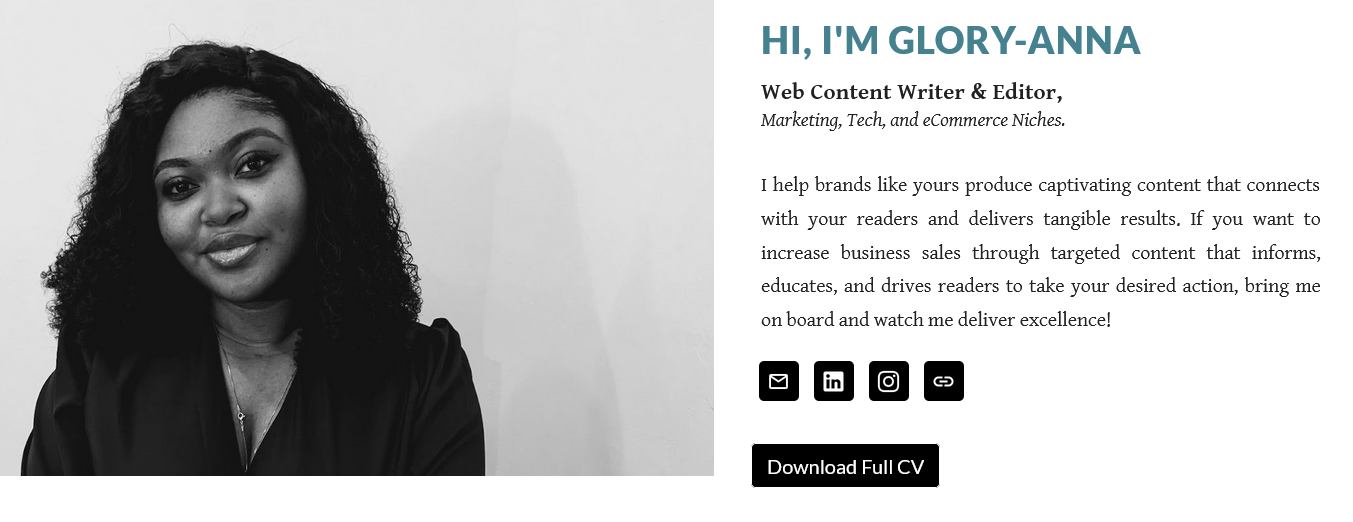
Fixing these mistakes helps your portfolio tell the right story about your skill, your professionalism, and your ability to deliver results.
Your 30-Minute Portfolio Audit
Take 30 minutes this week to audit your portfolio using these four checkpoints:
- Check your samples for typos and errors.
- Make sure the organization is easy to follow.
- Add enough context to explain the work.
- Check that your bio and contact information are clear and visible.
Your writing portfolio is your silent salesperson. Give it what it needs to do its job.
Ready to build yours? Try the portfolio tool I built at Writerlize Lab to create your writing portfolio. Then use the four checkpoints above to review it before you share it with potential clients.
You’ve got this!
If you have questions, I’m always eager to answer! You can email me, it’s delivered right into my inbox. Or you can shoot me a DM, whatever works.